
Rating: 3/5
Director: Razneesh Razy Ghai
Cast: Farhan Akhtar, Raashi Khanna, Ankit Siwach, Sparsh Walia, Sahib Verma, Dhanveer Singh
Genre: War Drama
Release Date: November 21, 2025
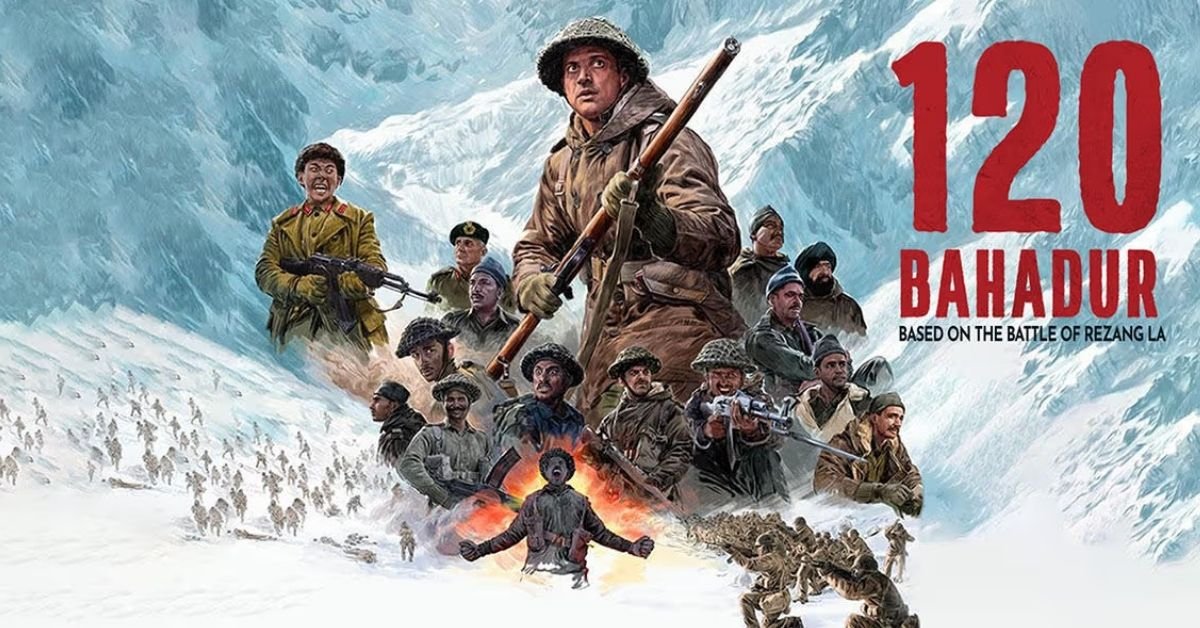
Films, which must not be viewed as pure entertainment, should be viewed as a reminder of history that has been forgotten. The 120 Bahadur by Razneesh Razy Ghai is one of them. The movie tries to give life to the screen the extra ordinary bravery of 120 Indian soldiers of the 13 Kumaon Regiment defending Rezang La during the 1962 Indo-China War. They were ill-equipped, there was little artillery support, and their opponent was a much stronger battalion in winter. Even though the movie conveys a good idea and, to a great extent, has a high level of respect towards its topic, it cannot translate this interesting piece of chapter into a movie that is truly moving.
120 Bahadur Review And Story aur Theme
It is a story of Major Shaitan Singh Bhati and his troop of Ahir soldiers who were on patrol at the frozen and inhospitable Rezang La pass. They are isolated without any support and resources to stand against the Chinese in massive numbers. The movie manages to shinelight the unknown fact that had the radio operator not managed to survive, this heroic tale could have been covered by the snow. The main theme is free of flaws: these men never tried to become patriotic by pronouncing any slogans; they led their lives without a song, and most of them died without glory.
The movie, however, becomes more of a praise song than a multi-faceted play. Although the realism of the military life is not lost, the emotional curve is not as high as the war movies must be. Rather than the establishment of emotional connection through organic methods, some of the scenes seem to be forced into the movie in order to create emotion.
Direction and Screenplay
Razy Ghai, the director, treats the subject with respect. His touch is not overt, as there are no exaggerated nationalist elements, bombastic film scenes and so on. Such a decision brings in reality and restricts emotional turmoil. The screenplay once or twice becomes quasi-documentary, the narration being simplistic regarding the events rather than delving into the minds of the men at the battle.
The usage of flashback, particularly the flashback of the family of Major Shaitan Singh does not add to the story, instead of enriching it. They are evidently crafted to intensify emotional investment yet they become foreseeable. The movie has something to say, but has not entirely found a way of making the audience experience it more than admiration.
Farhan Akhtar’s Performance
Farhan Akhtar also takes the role of the Major Shaitan Singh seriously and with dignity. The army leader does not need to use bombastic deliveries as some of the war movie heroes do. But this lowly connotation is a two-sided sword. His silence is effective in contemplative silent scenes but in those where there is the need to motivate or exert influence, the effect fails.
Akhtar is not a bad actor, however, he seemed to be a little miscast. The emotional connection that a war movie requires between the leader and the audience does not fully grow and the viewers admire the character without experiencing his sacrifice completely.
The Supporting Cast: The True Core of the Film
The youthful cast is the most convincing strength of the film. Ankit Siwach, Sparsh Walia, Sahib Verma and Dhanveer Singh make their roles unpolished in realism. Their friendship with food, their wrangles over trivial issues, and their fright concealed in the comic are most believable. Their dialogue to each other speaks more on the emotional tone of the film than flashback scenes.
Their killings are not performed to entertain. They are emotional, even hard to watch due to their commonness. These performances give the film what the human heartbeat desperately needs.
Cinematography and Music
Tetsuo Nagata manages to create one of the most influential effects with cinematography. Ladakh is not dealt with as landscape. Its perpetual silence, its blind, whiteness, and its cut-throat winds is a third enemy to the Chinese army. The camera does not only take the fights but also the horror of awaiting death in the cold where the skin burns in the frost before the bullets come.
The background score and the music particularly the song Yaad Aate Hai is good but not catchy. They do not have the haunting, lingering appeal that a war drama requires, particularly one of real history.
Writing: Strengths and Shortcomings
It is also a commendable aspect that the film is not over-patriotic. It is not based on loud chanting or flashy monologues. But it time and again brings out the Ahir identity of the regiment. Although technically the repetition is historically relevant, it is too emphatic, distracting and overpowered other character elements.
The writing is at its respect but fails in the emotional elevation. The movie does not always leave the viewer grieving about the soldiers yet it values them.
Final Verdict
120 Bahadur is a worthy endeavour of recording a significant military history that deserves much cultural credit. It is candid, genuine and aesthetically appealing. Nevertheless, the movie fails to make it the memorable war movie that it tries to be. It gives a noble tribute to the courageous soldiers but does not eternalize their history with such passion as it should be.
- The Paradise Movie Review: Nani’s Performance, Story & Verdict
- Woody Harrelson New Movie: What to Know
- The Uprising Movie Review: Andrew Garfield & Jamie Bell Shine
- The Dark Heaven Movie Review: Story, Cast, Rating & Climax
- Ghamasaan Movie Review: Arshad Warsi & Pratik Gandhi Thriller Explained
It is still a film that is significant but not iconic. It is worthy of viewing because of its purpose, the topic, and the acting, especially by the unknown actors. It does not go further to provide an emotional experience that can be memorable even after watching the screen goes black.
Rating: 3 out of 5
Conclusion
In case you want a war movie that is not jingoistic, and one that is able to depict the unknown heroes in their true light, then 120 Bahadur is a film worth watching. It may not be completely satisfying to those who are looking to find a visceral war drama that jolts you.