
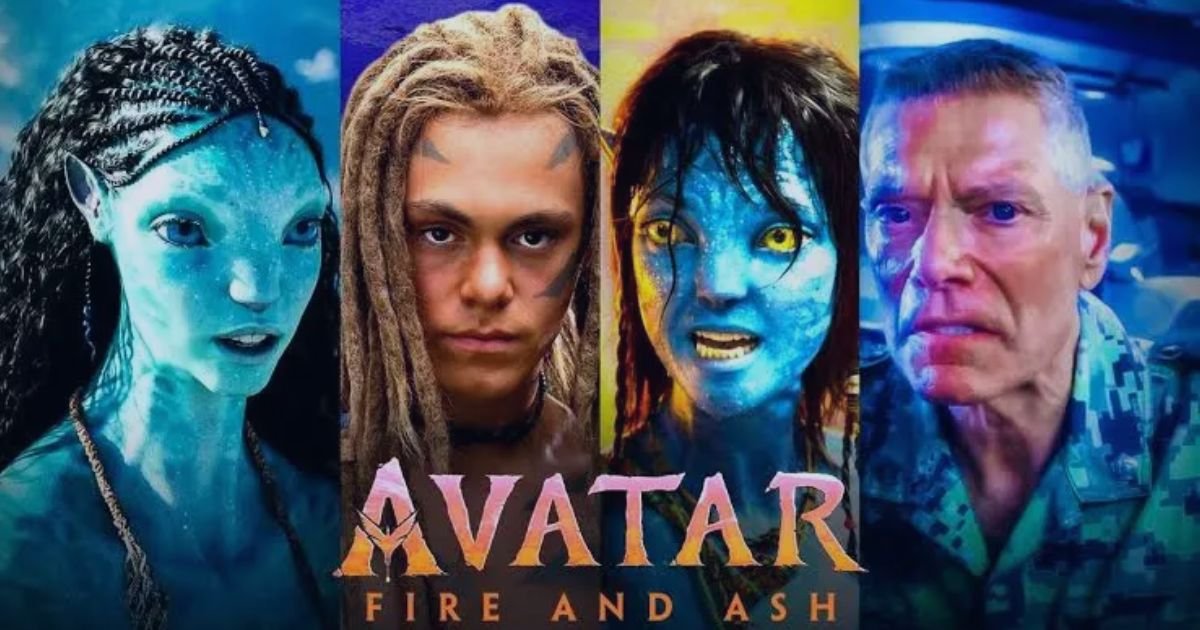
Avatar Fire and Ash Review : When Avatar: Fire and Ash arrived in theaters, the reaction was oddly familiar. Critics didn’t reject it outright. Audiences didn’t revolt. Instead, a quieter, more troubling consensus emerged: the movie looks astonishing, sounds massive, and yet feels… tired.
That reaction matters more than a star rating.
This isn’t just about whether James Cameron’s third Avatar film works or doesn’t. It’s about what happens when a franchise built on technical revolution reaches a moment where technology alone can no longer carry the emotional weight.
The Real Problem Isn’t Repetition — It’s Saturation
Most criticism has focused on repetition: familiar conflicts, familiar themes, familiar rhythms. But repetition itself isn’t fatal. Star Wars, Marvel, and even Fast & Furious have thrived on recognizable structures.
The deeper issue with Fire and Ash is saturation.
Pandora no longer feels undiscovered.
In 2009, Avatar did not only create a world, it also changed the definition of cinematic immersion. The Way of Water (2022) followed in the footsteps and created an experience that sent viewers somewhere they had never been before, in terms of imagery. By the year 2025, audiences will have spent almost a decade in Pandora. Sensory shock is absent as well and without it, the narration has nowhere to conceal itself.
When spectacle becomes expected, story becomes exposed.
Why Visual Mastery Isn’t Enough Anymore
Cameron remains unmatched as a technical filmmaker. The visuals in Fire and Ash are not just “good” — they’re among the best ever put on screen. But modern audiences, especially in the U.S., now consume blockbuster visuals weekly across films, streaming series, and even video games.
That raises the bar.
Spectacle is no longer the event. Meaning is.
It is not the fact that the movie is devoid of beauty, but rather that the beauty is no longer able to support thin character lines and to churn out predictable emotional clichés. The conflict between Naavis and humans, which was previously allegorical and new, at this point, has been resolved spiritually though not necessarily in plot.
In other words, the franchise keeps escalating scale without deepening consequence.
A Villain Problem That Signals a Larger Issue
Varang, the new antagonist, is a perfect example. On paper, she’s compelling: visually striking, ideologically extreme, aligned with humanity’s destructive forces. But she ultimately functions more as a symbol than a character.
That’s a warning sign.
Great long-running franchises survive by evolving their antagonists — not just their environments. Avatar still frames conflict externally (clans, colonizers, wars) when audiences increasingly crave internal stakes: moral ambiguity, fractured loyalties, irreversible choices.
Without that evolution, even powerful villains feel ornamental.
Why This Film Still Matters — Even If It Disappoints
Despite the criticism, Fire and Ash is not a failure. In fact, its reception may be the most important moment in the franchise so far.
For the first time, audiences are no longer grading Avatar on innovation alone. They’re judging it as cinema — alongside character-driven epics, prestige television, and emotionally complex blockbusters.
That’s progress.
It signals that Cameron’s work has moved from “technological marvel” to “narrative expectation.” Few filmmakers ever force that shift.
The Box Office Will Be Fine — The Legacy Is the Question
Financially, Avatar: Fire and Ash is unlikely to collapse. The brand is global, the visuals demand theatrical viewing, and loyal fans will show up.
But legacy works differently.
Provided that the future releases will remain based on the world-building without any emotional stakes, there is a risk that the franchise will be transformed into what it has avoided becoming: a flashy, but story-wise, standard blockbuster.
And that would be ironic for a series that once redefined ambition.
What the Next Films Must Do to Survive
With two sequels still planned, Cameron faces a creative crossroads:
- Shrink the scope, deepen the characters
- Let consequences stick
- Move beyond the colonization allegory
- Challenge the moral clarity of both humans and Na’vi
Audiences don’t need bigger battles. They need moments that can’t be undone.
If Cameron embraces that shift, Fire and Ash may be remembered not as the moment Avatar stumbled — but as the moment it was forced to grow up.
Final Take
Avatar: Fire and Ash isn’t exhausting because it’s long.
It’s exhausting because it asks audiences to feel wonder without offering discovery.
- Bigg Boss Tamil 10: Open Nominations Spark Major Clashes
- Carrie 2026 Review: Cast, Story, Release Date & Prime Video Series
- Khatron Ke Khiladi 15 Winner 2026: Avinash Mishra Wins ₹20 Lakh and Car
- Drishyam 3 Box Office Collection: ₹177 Crore Worldwide
- Drishyam 3 Movie Review: Ajay Devgn’s Thriller
And yet, even in that struggle, it proves something remarkable: James Cameron has raised expectations so high that visual perfection alone is no longer enough.
That’s not a failure.
That’s the cost of changing cinema forever.