
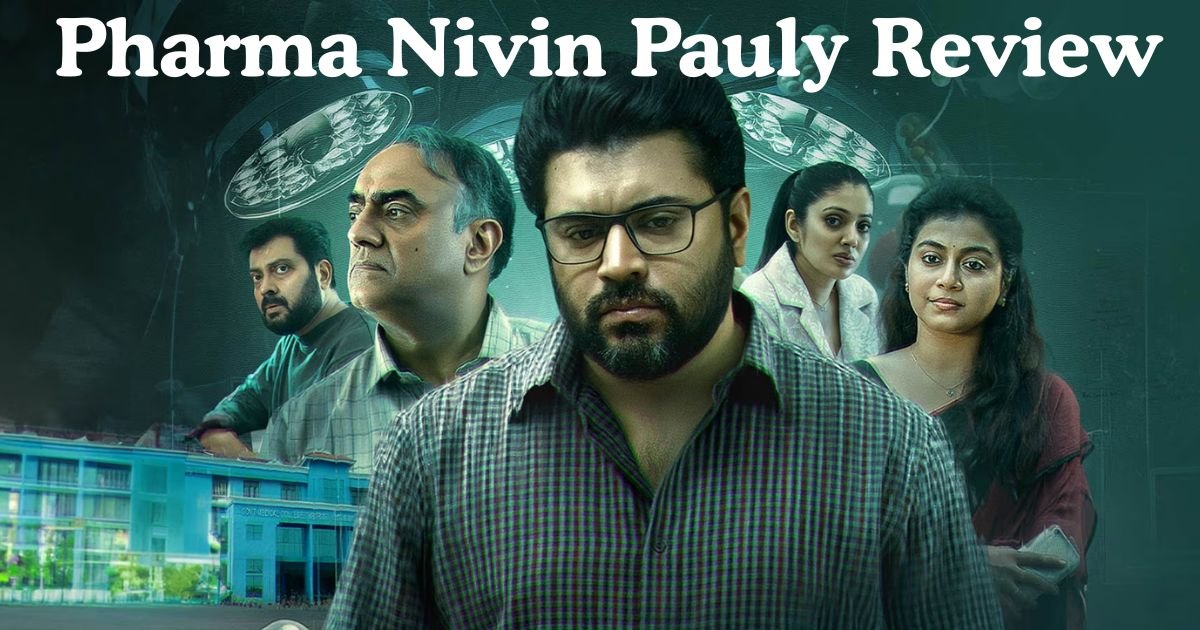
Pharma Nivin Pauly Review: Pharma falling on JioHotstar was not just another new Malayalam webseries that wanted to capture the attention in another already saturated OTT market. It silently heralded something bigger a reset moment, well, for an actor, and a genre, and the manner in which serious, issue-driven stories are starting to be approached over on Indian streaming platforms.
On the face of it, Pharma reminds of a standard-looking David vs.-Goliath thriller: one man, one giant corporation, and an ethical issue that will not remain under the carpet. However, the fact that the show is being discussed is more than its twists in the storyline or acting.
A Crucial Career Turn for Nivin Pauly
Over the recent years, the filmography of Nivin Pauly was lopsided. Less releases, less cultural moments, and increasing doubts on whether the actor who earlier on made a generation of Malayalam films had lost its luster. Pharma has a definite answer to that.
It is not a comeback that is loud and over-performed. Rather, it is a restrained, assertive act, which has to rely on restraint–a according that OTT values more than cinema proper. The series is a reminder to the audience why Nivin Pauly was hired to act in the first place: she is believable and not a star.
In the OTT ecosystem, where viewers binge characters rather than worship stars, that matters.
Why the Pharmaceutical Setting Hits Home in India
The environment of Pharma is what raises it. India is a huge pharmaceutical center in the world. Drugs here are lifelines and business products, and they tend to occupy a very uncomfortable middle ground between morality and money. The series exploits a subliminal anxiety that several Indians already possess, by setting its tale within this world, regarding the cost of drugs, clinical trials, corporate lobbying and belief in health systems.
This isn’t accidental. After the pandemic, Indian audience now is much more informed regarding the intersection of medicine, money, and power. A thriller whose basis is in this space intuitively becomes relevant even when fictitious.
That relevance is why Pharma doesn’t feel escapist. It feels reflective.
Rajit Kapur’s Return Is More Than Nostalgia
The fact that Rajit Kapur returns to Malayalam 25 years after his last performance could have served as a nostalgia gimmick. Rather, thematic weight is added by the fact that he is a senior doctor grappling with conscience. His personality embodies institutional memory – the voice of experience within the systems that tend to silence dissent.
This casting decision speaks volumes in terms of an industry. Actors capable of moral complexity as opposed to screen presence are becoming appreciated by OTT platforms. The emerging trend of streaming is indicated by the fact that Kapur is returning to a market where he cannot be hired by the movie industry to play significant roles.
What Pharma Says About the Future of Indian Web Series
The bigger story here is not just Pharma, but what it represents:
- Regional stories with universal themes are no longer niche. Malayalam content continues to punch above its weight nationally.
- Issue-based thrillers are replacing generic crime dramas. Audiences want substance alongside suspense.
- OTT is now a rehabilitation space for careers, not a downgrade. Actors can reinvent themselves here without box-office pressure.
- Long-form storytelling is winning. Eight episodes allow characters to breathe, conflicts to evolve, and ethics to feel earned—not rushed.
The Real Test Lies Ahead
Pharma is not perfect despite its advantages. It is not groundbreaking due to some pacing problems and the beats that are familiar in the genre. But that’s not the point. Its success is in the purpose and time.
Unless audiences give programs such as these the reward of repeated viewing, platforms will invest in original risk-taking storytelling. Otherwise, algorithms will drive creators towards less risky formulas.
In that sense, Pharma is not just a web series—it’s a litmus test.
And for Nivin Pauly, it’s proof that a comeback doesn’t need fireworks. Sometimes, it just needs the right story, told at the right moment, in the right medium.