
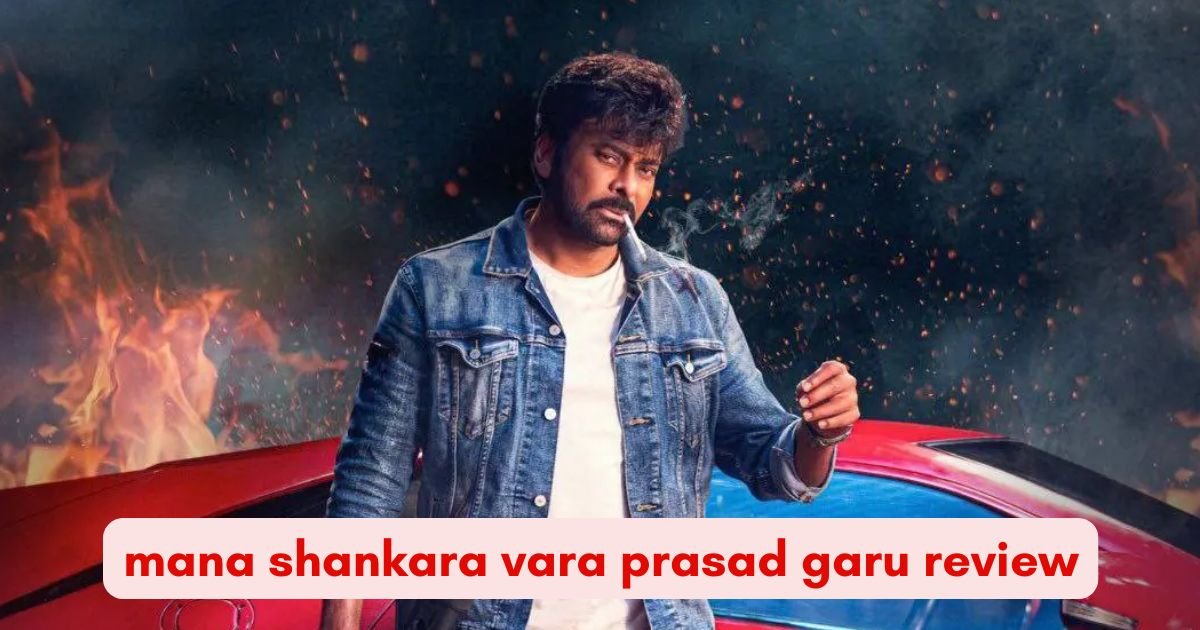
mana shankara vara prasad garu review: When Indian films are becoming all too obsessed with being realistic, dark and hyper-polished, Mana Shankara Vara Prasad Garu comes with a very different confidence. It does not attempt to re-invent the wheel. Instead, it is inclined to much stronger Telugu film element emotional recognizability, festival happiness and the long-term attraction of a megastar who knows what his viewers desire.
The film is not significant in that it flouts rules- but simply because it demonstrates that rules are not necessarily to be broken in order to win even in 2026.
Chiranjeevi’s Performance: The Art of Knowing Your Strengths
The most prominent thing is Chiranjeevi himself. He is not pursuing youth or being a fake invincible person at 70. Rather, he is a family-based, nostalgic and authoritative man- one who can be folding his laundry one minute and in charge of a room the next.
The positioning of the film in making him quiet intelligent. The move is calculated, the movements in the dance are controlled, and the humor is usually in his persona and not against it. It is not a matter of him proving that he can still, it is a matter of him proving that he never ceased to, he merely developed.
And to ethnic Telugu fans who might not be well versed in the star system of Telugu cinema, the film is a study on the nature of legacy stardom in India: not built on reinvention, but emotional continuity.
Anil Ravipudi’s Formula—and Why It Still Works
The director Anil Ravipudi has a reputation of being a commercial storyteller who is not sorry. In this case, he plays to his advantages of broad comedy, self-aware jokes, and scenes crafted to respond to and not be critiqued by the audience.
Yes, the plot is thin. Yes, quarrels might be sorted out in one heart-to-heart talk. However, that is not a weakness of this ecosystem- it is an asset. The logic is optional, and laughter is obligatory in the cinema of Ravipudi.
In the case of festival releases, such as Sankranti, such a strategy is not merely safe, but also tactical. The movie is constructed in such a way that it can be enjoyed in full theatres, families, laughter, applause can occupy the spaces where otherwise we can hear the nuance.
The Venkatesh Factor: Nostalgia as Currency
The long stay of Venkatesh Daggubati is more than fan service- and the investment of this emotion is calculated. His flashy vitality is in direct contrast with the calmness of Chiranjeevi, which generates a momentum that directly appeals to the memory of the audience about 80s and 90s Telugu movies.
Their dancing routine is not merely choreography, it is a ritual. An alert of common past between celebrities and the audience. Together with the influence of local identity in the cinematic industry, these scenes strengthen the strength of the pan-India release in the era.
Nayanthara and the Missed Opportunity
Nayanthara lends respect and authority to a character that should have had a lot more therein. She is a typical character, an elite, emotionally closed protagonist in contrast to a down to earth male character.
As she acts gracefully, the text restricts her performance. To foreign audiences, this brings out a lingering contradiction within mainstream Indian cinema in that well-known female actors are usually under-scripted in movies that feature male legends.
The future challenge for such cinema will be to evolve these dynamics without losing its core audience.
Technical Simplicity in a High-Tech Era
Visually and musically, the film does just enough. The cinematography is functional, the background score loud where it needs to be, and subtlety is rarely the goal. This isn’t a technical showcase—and it doesn’t pretend to be.
What’s interesting is that the film’s massive box-office opening suggests audiences are currently prioritizing emotional payoff over technical excellence. That’s a trend worth noting, especially for filmmakers planning big-ticket festival releases.
Why This Film’s Success Has Bigger Implications
The record-breaking premiere numbers signal something important:
Star-driven, culturally rooted films still have enormous commercial power—even without novelty.
For the Telugu industry (and Indian cinema at large), Mana Shankara Vara Prasad Garu reinforces three truths:
- Legacy stars remain box-office anchors when positioned honestly
- Festival cinema rewards familiarity more than experimentation
- Nostalgia, when handled with self-awareness, is not regression—it’s leverage
As streaming platforms push experimentation and globalized storytelling, theatres may increasingly become spaces for celebration, memory, and collective emotion. This film understands that divide—and exploits it effectively.
Final Verdict
Mana Shankara Vara Prasad Garu is not a film that asks to be analyzed frame by frame. It asks to be felt—in laughter, applause, and recognition. Its flaws are visible, but so is its intent.
And in a cinema landscape chasing the next big reinvention, there’s something quietly powerful about a film that says:
“We know who we are—and so do our fans.”
I just like the helpful information you provide in your articles