
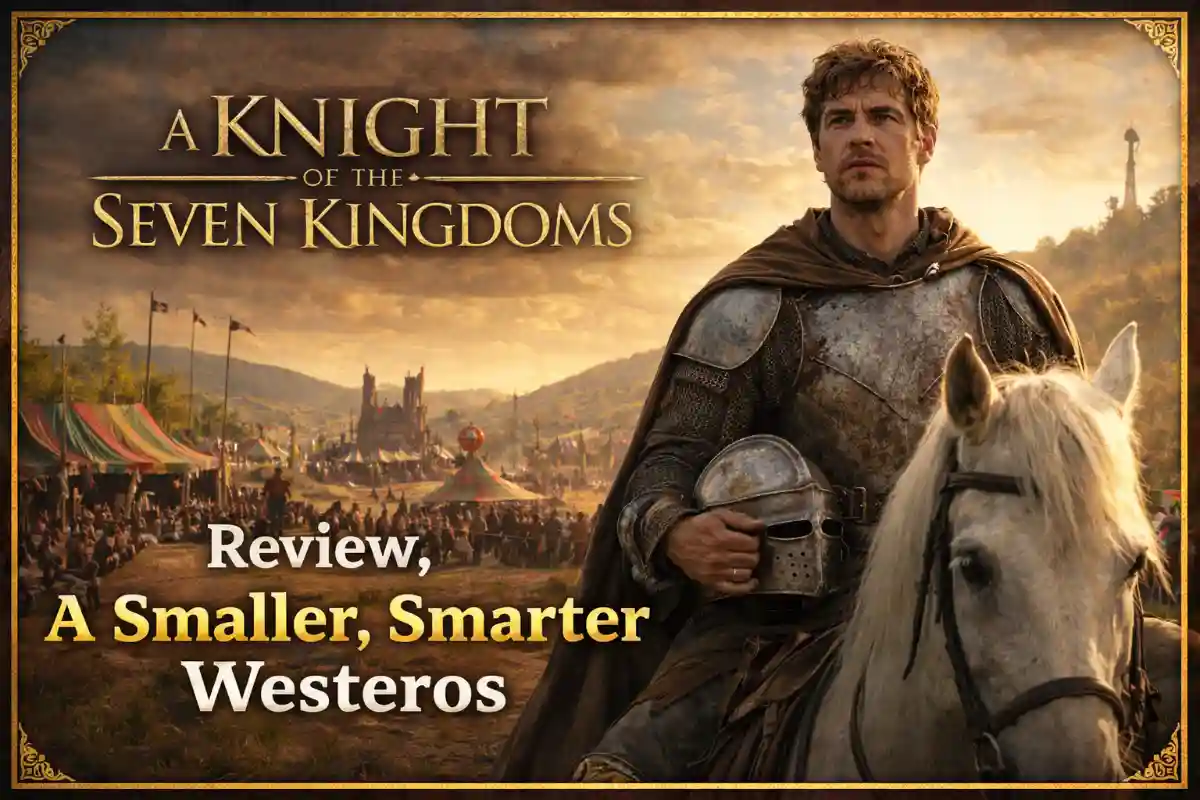
A Knight Of The Seven Kingdoms Review; Having spent decades with dragons erasing the sky and fates colliding on a continent-shattering scale, A Knight of the Seven Kingdoms comes, rather surprisingly, with a radically different thought: maybe the challenge would be better served simply by ceasing to try to conquer us?
This latest part of the franchise does not run after the end of the world. It does not run full burst in the direction of propagation crisis or oracle. Rather, it strolls, even literally, next to one man, his horse, and the human, petty issues that render heroism a thing to be won a second time.
That choice matters more than it might seem.
A Franchise Reset, Not a Retreat
Since more than ten years Westeros has been characterized by size. Bigger armies. Bigger monsters. Longer episodes. The idea was to escalate it, each new story was forced to seem bigger than the previous one to warrant its presence.
This series does not follow that trend. Shorter episodes. A narrower focus. Interests that commence with wounded pride and borrowed armor instead of the lives of kingdoms.
That’s not a downgrade—it’s a course correction.
The show downsizes the canvas, bringing back a missing element of the franchise that was slowly disappearing intimacy. When the story does not have thirty-odd plot lines running through it, it gives moments to breathe. Jokes land. Silences matter. Failure is more personal than strategic.
Dunk: A Hero Without a Destiny Clause
The one who is not chosen by the prophecy is Ser Duncan the Tall, Dunk to all who know him. He isn’t secretly royal. He does not give great speeches of honor.
He is, frankly, underprepared.
That’s exactly why he works.
Dunk is a member of a forgotten social group in Westeros hedge knights. Men, wandering, working, and living on opinion and not on blood. In a universe that is nuts about ancestry, Dunk is a symbol of something unobtrusively radical–merit without high birth.
The show leans into this idea with humor and humility. Its opening signals the tonal shift immediately, puncturing epic expectations before the title even settles on screen. The message is clear: this story knows where it comes from, and it knows what it’s poking fun at.
Comedy as World-Building, Not Distraction
Officially, the series is labeled a drama. Practically, it behaves like a dry, character-driven comedy with armor.
That distinction matters.
The humor isn’t there to undercut the world; it humanizes it. Jokes arise from discomfort, class tension, and the absurd logistics of medieval life—not from modern sarcasm pasted onto fantasy dialogue.
This approach does something crucial for longtime fans: it reminds us that Westeros is not just a map of power struggles, but a lived-in place full of awkward conversations, petty ambitions, and accidental friendships.
Egg and the Long Game of Storytelling
Dunk’s reluctant squire, Egg, initially appears as comic contrast—a sharp-tongued, oddly well-spoken boy who knows far too much about knights for someone without boots.
But the dynamic between them hints at something deeper: mentorship without idealization. Dunk is not a perfect teacher. Egg is not a starry-eyed follower. Their relationship grows through inconvenience, negotiation, and shared embarrassment.
For viewers familiar with the broader lore created by George R. R. Martin, this pairing carries long-term narrative weight. For newcomers, it works simply because it feels real.
That balance—rewarding deep fans without excluding first-timers—is one of the show’s quietest strengths.
Why This Matters for the Future of Big Franchises
Beyond Westeros, A Knight of the Seven Kingdoms reflects a larger shift in serialized storytelling:
- Audience fatigue with constant escalation
- Renewed appetite for character-first narratives
- Shorter runtimes that respect attention without sacrificing depth
In an era where franchises often collapse under their own mythology, this series demonstrates a sustainable alternative: expand the world by zooming in, not out.
If it succeeds, don’t be surprised to see other major universes attempt similar “small story” experiments—side tales that rebuild emotional trust before chasing spectacle again.
The Quiet Pleasure of Watching Someone Try
This is essentially not a tale of tournament victory and legitimacy. It is about seeing a person with few means make good decisions, lose in front of people, and just continue regardless.
That may not sound epic. But it’s something far rarer in modern franchise television: relatable courage.
- Jailer 2 Review: Dhanush Calls Rajinikanth’s Film a Blockbuster
- Bigg Boss Tamil 10: Open Nominations Spark Major Clashes
- Carrie 2026 Review: Cast, Story, Release Date & Prime Video Series
- Khatron Ke Khiladi 15 Winner 2026: Avinash Mishra Wins ₹20 Lakh and Car
- Drishyam 3 Box Office Collection: ₹177 Crore Worldwide
And in a genre where fantasy is constantly trying to outdo each other with volume, gloom, and destruction, a small knight on a dusty road can be just what the genre needs at this moment.
i enjoy reading this great article, i have shared it many times on my website and started following you, Do you post more often ?? i am the owner of https://webdesignagenturbayreuth.de/ a webdesign agency in bayreuth Germany, webdesign agentur bayreuth, you can link up if you are interested. Thank you