
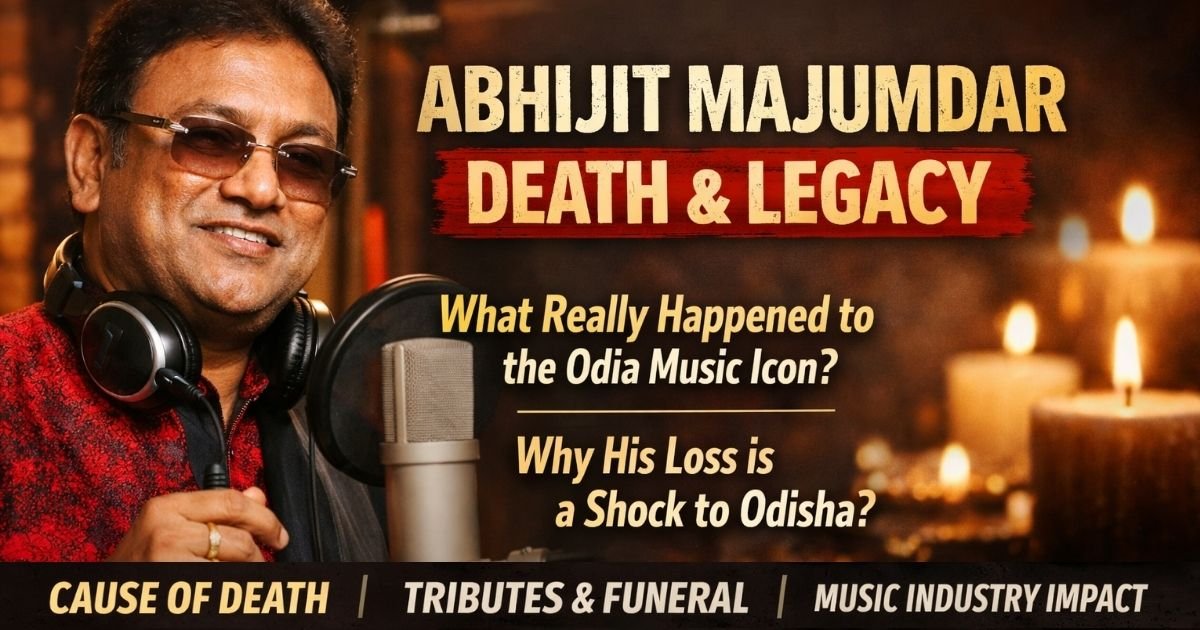
The death of Abhijit Majumdar is not an ordinary obituary in the entertainment section. To Odisha, it is as though the radio tune, which had been taken in unison by life, was abruptly silenced. Baba Buddy is a singer-composer whose music background spanned across generations, movies, festivals, and intimate life events, according to Odia music industry.
The end of the life of Majumdar at AIIMS Bhubaneswar brings an end to a painful ordeal of months of sickness, numerous visits to the hospital and a struggle that his followers had waited with. To realise why this moment is important we should go past medical bulletins and condolences.
More Than a Medical Update: What Actually Happened
Abhijit Majumdar had been experiencing severe health issues in the last few months. His health had been alternating between delicate stability and acute danger, during which he was hospitalized in September 2025. Hospital reports indicated his health has significantly declined at the end of January after his new infection happened which led to refractory septic shock, one of the worst and hardest to treat emergencies in critical care.
He had a cardiac arrest early in the morning of January 25. Emergency life saving measures were taken by the doctors, but he was not revived despite the prolonged care.
This information is significant, not in terms of morbidity, but in terms of highlighting the unexpectedness and inexcusability of critical illness even with sophisticated medical care.
Why His Death Resonates So Widely
Abhijit Majumdar was not a celebrity who was confined to niche audiences. His music went way beyond movie theatres. They performed during weddings, temple festivals, radio requests, and long bus rides and headphone sessions at night. To most Odia listeners, his music did not have to be listened to – it just went with life.
That’s precisely why his loss feels personal.
At the time when regional music is frequently not seen nationally, Majumdar was a demonstration of the fact that cultural richness does not require viral algorithms to protect itself. There was emotional simplicity, lyrical minimalism, and melodic discipline in his work that is becoming more and more uncommon in high-volume, high-turnover music systems.
A Cultural Loss, Not Just an Industry Loss
Tributes poured in from across political and cultural circles, including leaders who acknowledged that his contribution extended beyond entertainment. That recognition matters.
Odishi music has traditionally been used to defend language, emotion, and collective self. Such composers as Majumdar were not merely making music but were storing cultural memory. With such an individual out of the way, the loss is cumulative: there are no more voices to train the newcomers, no more links between the sensibilities of the classics and the production current, no longer a reference point to tradition.
The Social Media Generation Knew Him Too
Unlike the belief that old musicians are irrelevant and disappearing, Majumdar still managed to be visible and human on the internet. His social media pages captured normal life times, travelling, rehearsing, personal thoughts, not the star image. This candor made the younger audience identify with him not as a remote myth, but as an artist who is in the studio, continuing to talk to his listeners.
That’s why news of his passing spread so fast. It wasn’t just reported; it was shared with grief.
The Unspoken Conversation: Artist Health and Industry Pressure
There’s another layer to this story that deserves attention.
Artists in the regional industries particularly do not have the safety nets enjoyed by their counterparts in bigger markets. Uncomfortable, yet, real problems are long schedules, uneven income flows, stress, and delayed medical intervention. The long-lasting illness of Majumdar, as well as the stunned response of the population to its result, unobtrusively suggests whether access to healthcare and early diagnosis and support of creative people is an issue at all.
His death may yet spark conversations the industry has postponed for too long.
Family, Farewell, and Final Rites
Abhijit Majumdar leaves behind his wife, Ranjita Majumdar and a son. His mortal remains, the family sources say, were transported to Cuttack and the final rites were given there, in a new land with the folk and culture he was accustomed to, and around which his music was constructed.
There is dignity in that closure, even amid sorrow.
What His Absence Means Going Forward
The short term will be characterized by tribute concerts, retrospective play lists and re-appreciation of his catalogue. However, there is an influence in the long run that is more subtle.
Young Odia musicians will also be brought up devoid of the silent standard his work offered. Manufacturers will miss having a partner who knew how to restrain himself. Even though this may be subconsciously, audiences will realize that something familiar is not being produced any more.

And that, perhaps, is the truest measure of his legacy.
A Voice That Doesn’t Really Fade
The artists such as Abhijit Majumdar do not vanish upon their death. they disintegrate into memory precis of old soundtracks, communal jokes and songs that pop out of the blue many years afterward. His voice will come back when you are least expecting, in a song you had forgotten that you had missed, at a time you had not anticipated.
That is how cultural immortality works. Quietly. Persistently.
And Odisha will keep hearing him.
i enjoy reading your articles, it is simply amazing, you are doing great work, do you post often? i will be checking you out again for your next post. you can check out webdesignagenturnürnberg.de the best webdesign agency in nuremberg Germany