
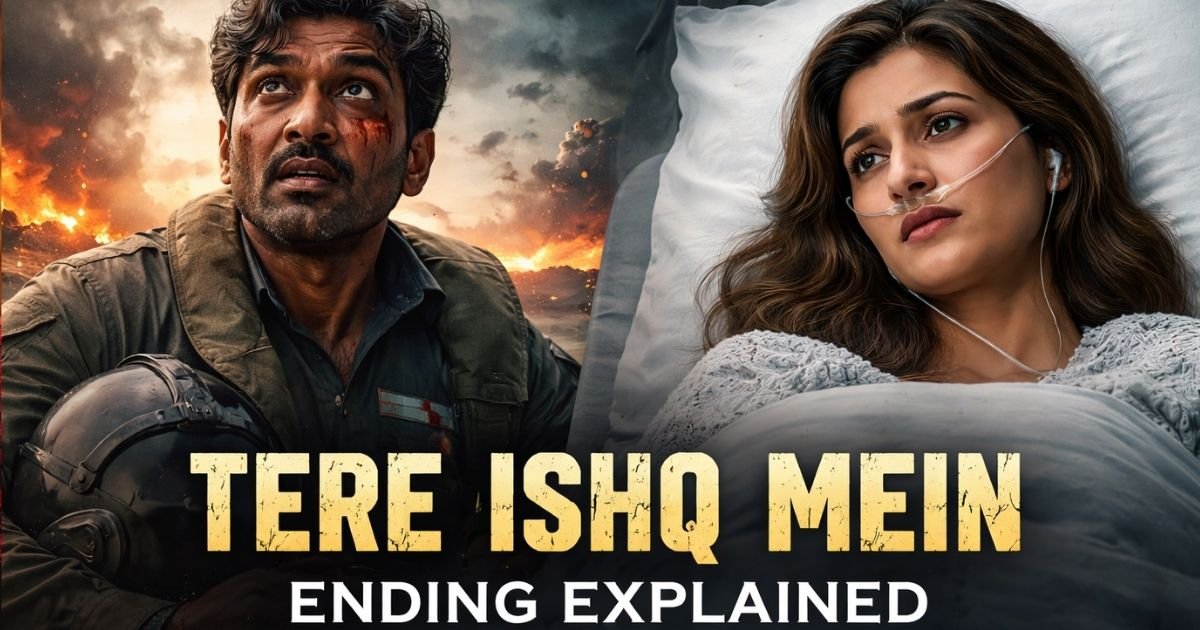
Tere Ishq Mein Ending Explained
Tere Ishq Mein does not end like a love story. It ends like a verdict.
Tere Ishq Mein does not end like a love story. It ends like a verdict.
By the time the final explosion fills the screen, the film has already made up its mind: some kinds of love don’t heal, don’t mature, and don’t deserve survival. What they deserve is consequences. That’s what makes the ending so unsettling—and so difficult to forget.
This is not just about whether Shankar and Mukti die. It’s about why the film believes their love had to.
A Reunion That Was Never Meant to Save Anyone
The film does not interfere with the nostalgia when Shankar and Mukti reunite after some years. It does not have a lost love rekindled fantasy. Shankar (who is played by Dhanush) has acquired a uniform and discipline, but lacks emotional clarity. Mukti (Kriti Sanon) has established an academic and marital life, but is emotionally a wreck with unresolved baggage.
The reunion of their meeting in Leh is built on the context of control, but not love. It is not love that causes Mukti to refuse to sanction Shankar to work: it is fear. She fears death, fears that her husband might die in war and fears abandoning her child. She reinstates Shankar in that dread to a position he never desired to occupy future caregiver, emotional surrogate, moral insurance.
The film is clear here—this isn’t destiny pulling them together. It’s desperation doing the damage.
Why the Pregnancy Changes Everything (and Nothing)
The unborn child enters the moral centre of the climax, but without being sentimental. Mukti does not request Shankar to fall in love with her. She requests him not to die on behalf of the child. That distinction matters.
In one devastating emotional move, she turns love into obligation.
In a psychological perspective, the behaviour of Mukti follows emotional dependency instead of romance. She does not believe in structures, organizations, not even her marriage, she believes in a man who killed himself because of her. The tragedy lies in the fact that Shankar allows himself to be framed so.
That’s the moment the ending becomes inevitable.
The Crash Was Not Heroism—It Was Closure
When Shankar refuses to eject and crashes his jet into the enemy target, the film does not score the moment like triumph. There is no patriotic swelling, no slow-motion glorification.
His death is quiet in intent, loud in consequence.
This is not something that concerns the country. It is not even much about Mukti. It’s about ending a pattern. In the film, the love of Shankar manifests itself: too much emotion, too much anger, too much devotion. The crash is the last extension of that extravagence, excepted not within but outwards.
He doesn’t die because he has nothing to live for.
He dies because the film believes he has nothing left to fix.
Does Mukti Die? The Film’s Silence Is the Answer
The film never shows Mukti’s death on screen—and that choice is deliberate.
Her hospital scenes are drained of hope, not drama. There’s no dramatic farewell, no last confession, no cinematic release. The implication is clear: survival would be a mercy this story does not offer.
If Shankar’s death is certainty, Mukti’s is consequence.
Together, their implied deaths complete the film’s thesis: love rooted in obsession doesn’t evolve—it corrodes.
Why Jasjeet’s Survival Matters More Than You Think
One of the most important shots in the ending isn’t of Shankar or Mukti at all. It’s of Jasjeet, Mukti’s husband, alive on his naval ship, watching the explosion from afar.
This single image reframes the entire climax.
Shankar’s sacrifice doesn’t reunite him with Mukti in life. It ensures her child will grow up with a living parent—just not him. The film quietly rejects the idea that love entitles someone to legacy.
Shankar’s reward is not family. It is erasure.
A Darker Successor to Raanjhanaa—By Desig
Director Aanand L. Rai has often explored obsessive love, but Tere Ishq Mein is where he finally stops romanticising it. If Raanjhanaa asked whether obsession could be forgiven, this film answers: no.
Even the music by A. R. Rahman resists emotional manipulation in the final act. Themes fade instead of soaring, reinforcing the emotional emptiness left behind.
The film doesn’t want tears—it wants reflection.
What the Ending Really Says About Love
At its core, Tere Ishq Mein argues something deeply uncomfortable:
- Sacrifice is not always noble
- Passion is not proof of purity
- And love that demands self-destruction is not love—it’s collapse
Shankar and Mukti don’t die because fate is cruel. They die because the relationship they built could not coexist with life, responsibility, or the future.
That final explosion doesn’t just end a mission.
It ends an idea—that suffering makes love meaningful.
Final Take
The Tere Ishq Mein ending explained has nothing to do with de-coding the plot. It is all about knowing purpose. The movie does not imply that you should lament its characters. It challenges you to wonder why you ever sided with them.
And that is precisely why the ending hurts long after the screen goes black.
wow your article is simply a masterpiece, i like that, keep it up and will be checking for new update. do you post often? you can check the biggest webdesign freelancer in platform in germany called https://webdesignfreelancerfrankfurt.de/ Thank you for your wonderful post