
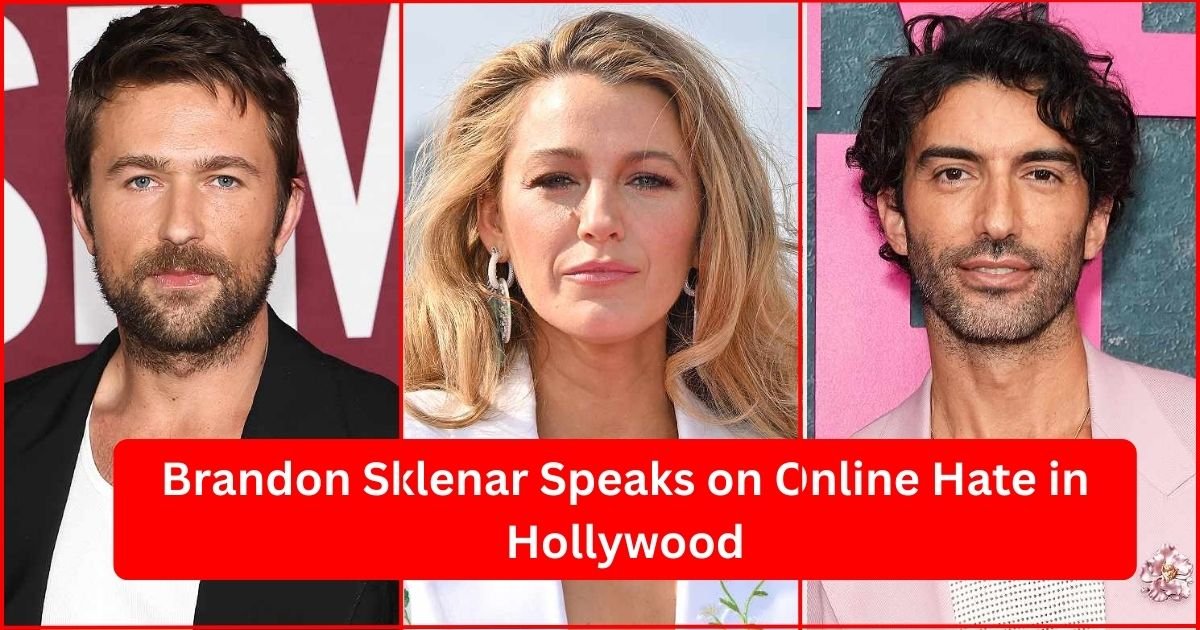
Brandon Sklenar Speaks on Online Hate in Hollywood: In the modern entertainment world, the loudest fights do not necessarily occur on screen or in a legal courtroom, they break out online. The reality of that Zucker was just recently revealed by actor Brandon Sklenar, when a figure in the limelight is going into a controversy, even timorously. It is not a story of a single film or a single feud but of how the current celebrity culture, social media frenzy, and gender politics intertwine and become toxic within a very short period of time.
A Film Overshadowed by Noise
It Ends With Us (2024), an adaptation of a novel with the same title by author Colleen Hoover, was intended to emphasize themes of resilience, love and women making safer, healthier decisions, which is a central theme in her novel. Rather, much of the mass media chatter centered on the speculation of a conflict of its two lead characters, Blake Lively and Justin Baldoni.
The crossfire entangled Sklenar who was a major supporting figure. In one of his social media posts, he wrote to people to go back to kindness and the main message of the film during his press tour. Not an attack or a defense–merely a request to make the enmity a little more mild. The response, according to him, was violent, as in messages that hoped he would die or his career should be terminated.
Why This Matters Beyond One Actor
The experience that Sklenar describes underscores a greater cultural change: social media has broken down the barrier between fans and musicians, but such a barrier has been removed without the filters that once filtered the influencing behavior of the extremes. What was formerly being shouted into the vacuum is now appearing in the inbox of a person.
This is an actual implication to Hollywood. The actors are being asked to become more morally vocal, but are penalized when moral voices fail to be absolute reflections of the internet polarization narratives. The fact that one side or the other is neutral, or even demands empathy, can be construed as betrayal.
The Gendered Undercurrent
The backlash also highlights the way in which the discourse of gender and power unfolds in the public. When Baldoni was later sued after the allegations of sexual harassment and retaliation were made against Lively (which Baldoni has denied), Sklenar openly invited people to read the complaint itself. His position encouraged listening and understanding and not speculation.
This is a scene of larger accountability in the business: the opinion of the people is usually created quicker than facts, and whoever is seen to shape that opinion is a target–whether intentionally or not.
The Psychological Toll of Being “Always On”
Sklenar has talked of how it is difficult to resist reading hateful comments in that it is like overhearing people in a room full of strangers discuss you. Media psychology specialists observe that this reciprocal could be unmatched harmful. Online abuse is not a one-off event as with traditional criticism, but it is personal and sustained, and unlike traditional criticism, it is supported by algorithms that encourage outrage to be seen.
For emerging actors especially, the fear is clear: speaking thoughtfully may cost you peace of mind, while silence may be read as complicity.
Looking Ahead: A Warning Sign for the Industry
With the legal battle between Lively and Baldoni heading to a trial in 2026, the discourse surrounding it is unlikely to reduce any time soon. Recalibration is what the story of Sklenar is pointing to: studios, platforms, and audiences.
- For studios: clearer strategies to protect cast members during controversies.
- For platforms: stronger moderation tools that don’t normalize harassment.
- For audiences: a reminder that real people sit behind the screens we comment on.
Sklenar continues to work, now appearing in new projects and earning praise from collaborators. But his experience lingers as a cautionary tale: in an era where every opinion is public and permanent, even a call for kindness can come at a steep personal cost.