
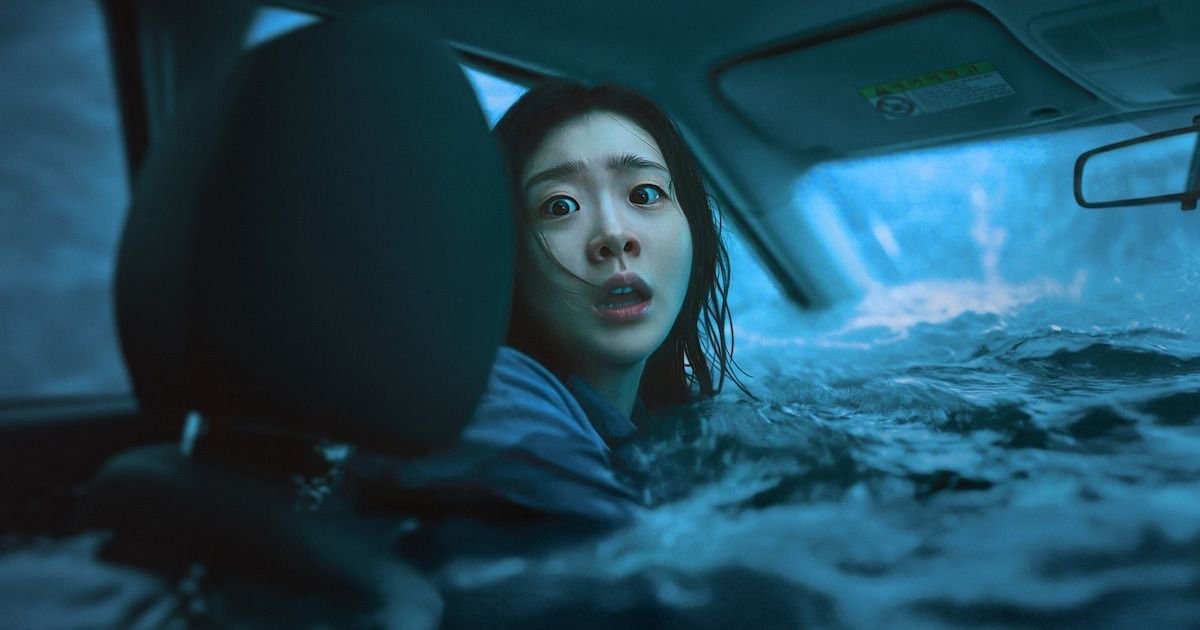
The Great Flood Movie Explained: Upon viewing, The Great Flood appears to be just another film added to the ever-expanding list of international disaster films on Netflix: massive waves, people fleeing, and people clamoring to get on top. However, under the crumbling buildings and the continuous torrents of rain, this Korean thriller is up to much more disturbing – and much more timely to the contemporary audience.
It is not a film about climate disaster survival. It is a film on what we are ready to simulate and sacrifice and even optimize under the survival.
A Disaster Film That Quietly Changes the Rules
Traditionally, disaster films are based on one thing, that is, in case the main character struggles enough, he will emerge alive. The Great Flood purposely upsets that anticipation.
With Seoul drowning in the inexplicable, civilization-ending rain, scientist An-na (portrayed by Kim Da-mi) and her young son begin to climb up the high-rise, which is collapsing. The arrangement is also very comfortable until it is not. Slowly the film shows that the flood is not merely a threat outside, but one of the elements of a highly guarded test involving artificial intelligence, mimicking of emotions and even crafting the attachment between humans.
By the moment the audience understands what we actually have to lose, the film had silently slipped past its genre boundaries, that of a survival thriller, and turned into a psychological sci-fi.
Why This Story Hits Harder in 2025
What makes The Great Flood resonate isn’t its spectacle, but its timing.
We live in an era where:
- Algorithms curate our emotions
- AI models simulate empathy
- Data is used to predict human behavior
The film asks an uncomfortable question:
If emotions can be replicated, do they still have moral weight?
An-na’s repeated choices — whom she saves, whom she ignores, and how she reacts under pressure — feel eerily similar to how modern systems are trained today. Iteration. Feedback. Optimization. Repeat.
This isn’t science fiction as fantasy. It’s science fiction as mirror.
The Role of Authority and Control
The character of Park Hae-soo, played by Park Hae-soo, is the embodiment of institutional tranquility in the face of turmoil the voice that says that the experiment has to go on because the stakes are too big to fail.
Western audiences can relate to that framing. Similar excuses have been cited in discussions on surveillance technology, killer robots, and mass AI. The movie does not scream its criticism but it does not conceal it either: when survival turns into a system, human beings turn out to be variables.
Imperfect Storytelling, Intentional Discomfort
Critics have pointed to the fact that the story can be fractured or disorienting, particularly in the later acts. However, the experience might include that confusion. With the repetition and reflection of the story, the viewer is, like An-na, confused as to what is real and what is a simulated and what really matters anymore.
The movie, aesthetically, switches both between the spectacular level of destruction and calculatedly unreal digital spaces, which only strengthens the impression that even reality is not hard to lose.
What This Means for Netflix — and for Viewers
The Great Flood, being a Netflix production, is also indicative of a change in entertainment the world over. The exporting of spectacle is no longer the only thing that international films do, but export ideas. Korean cinema, specifically, is still continuing to incorporate genre thrills with philosophical discomfort in the vein of films that push the audience in the direction of challenge instead of reassurance.
For American viewers accustomed to clean resolutions, this movie may feel unsettling. That’s the point.
The Bigger Question the Film Leaves Behind
By the final moments, The Great Flood isn’t asking whether humanity can survive extinction-level events.
It’s asking something far more dangerous:
If we can engineer love, empathy, and sacrifice — who decides how much they’re worth?
That question lingers long after the waters recede.
The Great Flood is now streaming on Netflix — and it’s less about escaping disaster than realizing we may already be inside one.