
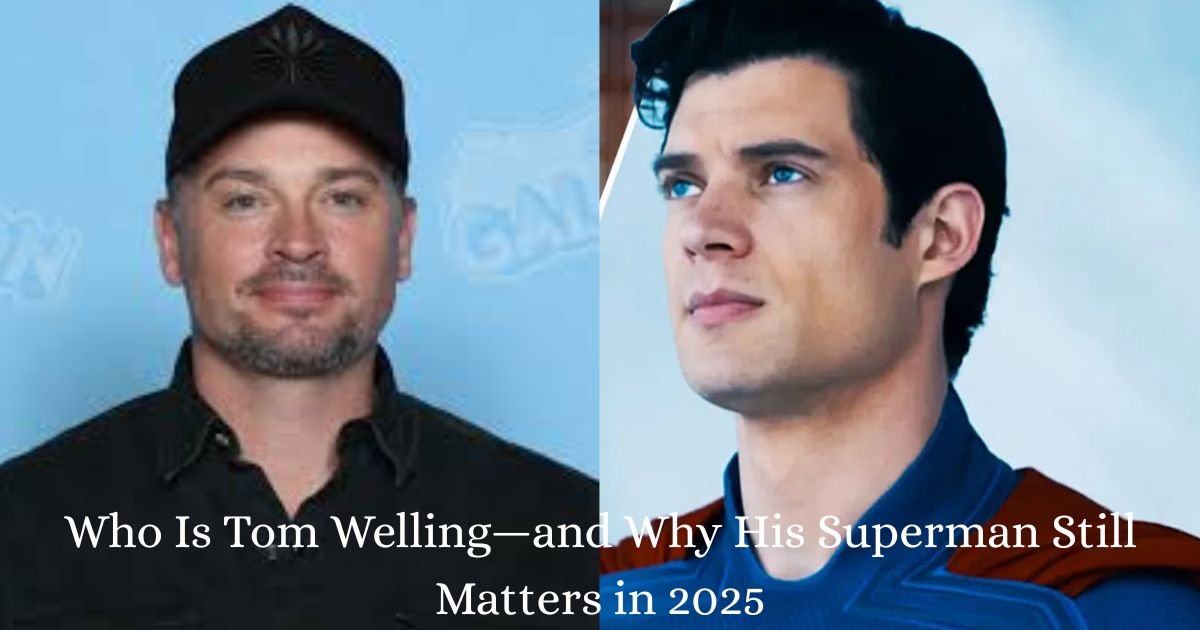
Who is Tom Welling: To Canadian viewers who would have been exposed to cable television at the beginning of the 2000s, Superman was not a movie character, but a weekly tradition. And at the heart of that time period was Tom Welling, the actor who reinvented the character of Clark Kent into a single generation courtesy of the long-running television series Smallville.
Nowadays, Welling is in the headlines again, however, not due to the wearing of the cape, but by the newest Superman, David Corenswet, stating that Welling was his favourite Superman. That approval has helped to renew attention to the identity of the man behind the mask, Tom Welling, and why his interpretation of the Man of Steel still has further to travel more than 20 years later.
The Superman Who Grew Up With His Audience.
Welling did not come as a fully-fledged Clark Kent as big-screen Supermen do. Smallville was a narrative of slow-burn origin-story; ten seasons of growing up, moral conflict, friendship, and identity. The audience did not watch Superman, they grew up with him.
This approach mattered. To the Canadian teens in the early 2000s, Smallville was aired during a period when the use of the superhero narratives was going more personal and more character-oriented. Even before the idea of the cinema universe became industry lingo, the Clark Kent of Welling demonstrated that emotional growth might be as appealing as superpower.
The reason why the praise of David Corenswet is important.
It was no accident when David Corenswet (who plays Superman in James Gunn’s Superman: Legacy) claimed that Tom Welling was his Superman. It was a signal.
Corenswet is part of the generation of people that were watching Superman weekly, not only in theatres. His remarks point to a cultural handoff: a Superman of the TV era which affects a new film re-launch. The fact that continuity is important is that it demonstrates that, even as the storytelling of superheroes changes in terms of format, the DNA of emotion can remain.
Outside the Cape: Wider Career of Tom Welling.
Although Welling has always been identified with Clark Kent, his career did not end as soon as Smallville was discontinued in 2011. He moved to film, maturity television where he appeared in such projects as Cheaper by the Dozen, The Fog, and subsequent appearances in other films as Marcus Pierce in Lucifer. He was also a director and producer of the film–creative decisions that indicate long term creative life and not typecasting.
To Canadian audiences, this change is a reflective one to the larger entertainment phenomenon: TV actors rebranding themselves in a time when prestige television and streaming are breaking down the old industry lines.
Why This News Matters Now
Superman is again on the cross road between cultures. Reboots, old school casting and evolving viewer demands are causing the fans to rethink what it takes the character to stand the test of time. It is not an issue of ranking Supermen but rather the issue of acknowledging impact when Tom Welling resurfaces.
- His portrayal proved that:
- Superman does not have to be as spectacular in the moment to be successful.
- Storytelling requires more time, which forms greater fan loyalty.
- Human, down-to-earth Clark Kent can be a generation.
At a time when the reset button is gaining more and more popularity, the Superman by Welling is something of a rarity: patience.
P De Futuris: The Effect of the Past.
With a new epoch in Superman: Legacy there will be a continuing presence of Tom Welling- at least to those who are not fond of watching chaos and confusion. His Clark Kent is still a standard to Canadian viewers who were watching Smallville after school or through weekend reruns.
All Supermen need not fly at all. The others have to know how to stand.
And that is, more than anything, why Tom Welling is still in the news today.