
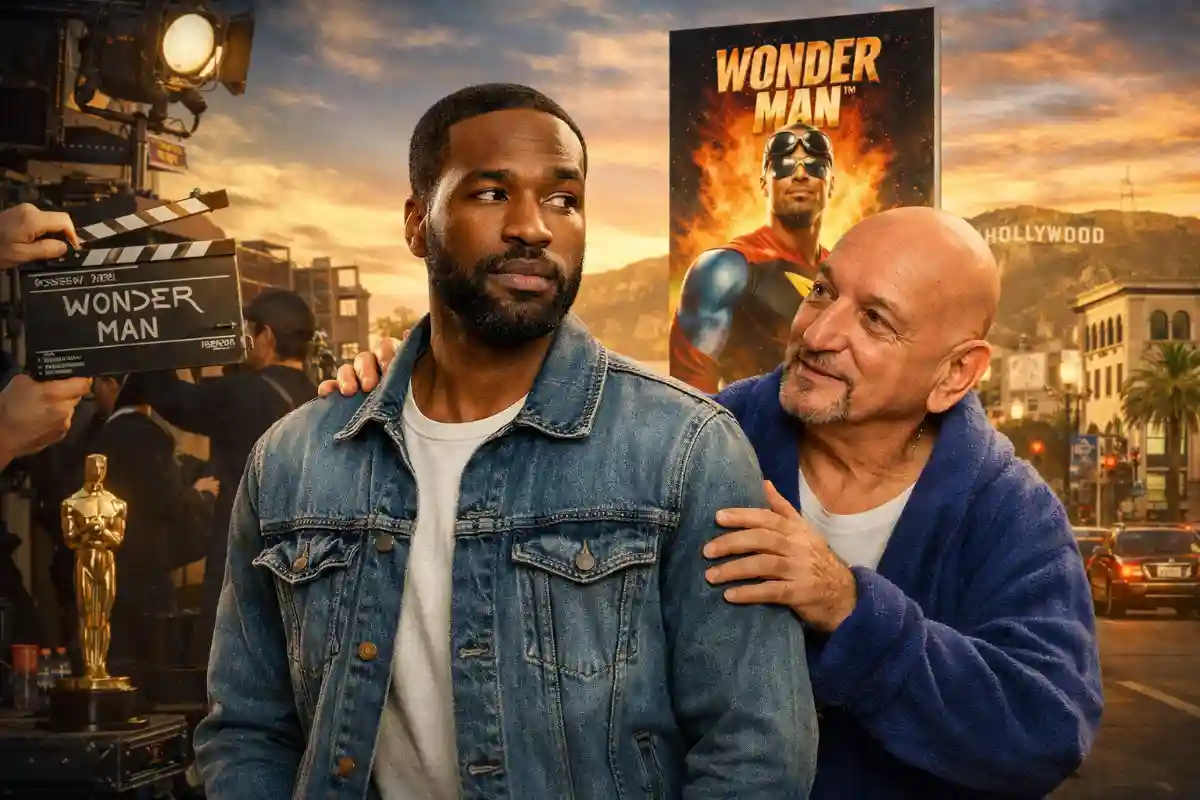
Wonder Man Review: Over the years the biggest asset that Marvel has never had was scale, spectacle, or even continuity. It’s been restraint. And Wonder Man, the most recent Disney+ original by Marvel Television, makes that argument somewhat subtly, but better than the studio has been able to do in a long time.
It is not a tale about portals ripping open the sky or evil threatening the very existence. It is of auditions that fail to go well, careers that rip to a halt without much or any notice, and the silent horror of understanding that you may never turn out to be who you thought you were meant to be. That is, it is about Hollywood. And about being human in a universe that is generally unkindly dispositional of that.
A Superhero Story That Barely Wants to Be One
Fundamentally, Wonder Man is not fascinated with the powers, but pressure. Simon Williams is not presented as a future hero or a hidden sword, he is a poor actor whose greatest foe is his personal no self-confidence. His powers are almost accidental and related to emotional stress instead of heroism. That choice matters. It reinvents super powers as not gifts, but liabilities, particularly within a business that promotes itself on domination, predictability and branding.
The most revealing invention of the show is not a villain or a MacGuffin, but a policy, the so-called “Doorman Clause that silently prohibits people possessing superhuman powers to be employed in films and TV. It is a stinging, virtually inhumane metaphor of the long history of Hollywood gatekeeping, how difference, even when it has its value, is often handled as an asset that must be controlled, not an asset that should be capitalized on.
Hollywood as the Real Battleground
Placing the action in the entertainment industry itself, Wonder Man manages to do something that the MCU has not done in a long time: it looks inward. The casting directors, agents, reboot culture, revival houses, and washed-up legends are not the background flavor, but it is the ecosystem, which the characters are struggling to survive in.
The show knows one of the key things, most people do not have cosmic stakes that are involved. They’re personal. The second audition may seem more significant than the end of the world. The loss of a job may be a worse blow than the loss of a battle. Wonder Man admires the use of emotional mathematics and it is the reason why even the series that seem to be based in the real world feel grounded despite reality being bent.
Mentorship, Aging, and the Cost of Reinvention
The emotional aspect of the show lies in the relationship between Simon and Trevor Slattery. It is not merely comic relief or nostalgia, it is an experiment into what follows the spotlight. Trevor is a man who has lived many lives, crossed bridges, and has been taught (sometimes badly) that there is always a cost of reinventing oneself.
Their relationship lacks the mentor stereotypes. Trevor is not there to shape a hero, he is there to project a prospect- both optimistic and worrisome. The series uses him to explore a too little talked about topic of superhero storytelling, which is aging as a culture where people are obsessed with being young, relevant, and reimagining themselves.
Why This Approach Works Better Than the Movies Right Now
Recent Marvel movies have been crumbling under the burden of necessity – pre-establishing future stages, cross-selling, universe upkeep. Wonder Man avoids all that. There is no need to have a roadmap or some prior knowledge or even to be emotionally invested in the franchise to be concerned about what is going on here.
That freedom enables the show to make risks: reduce the number of action scenes, increase the number of conversations; reduce the number of villains, have more internal conflict. This would be the opposite of the MCU that needs more complex concepts and concepts with more small-scale storytelling.
What Wonder Man Signals About Marvel’s Future
Wonder Man is no simple series, as it is a muted blueprint to Marvel, should he be listening. It recommends that the future success of the studio could be based not on escalation but on specificity. Narratives concerning individuals, locations, and strains viewers are familiar with. Characters whose issues do not fade away following the credits.
The implicit message behind the show is simple and at the same time, very strong, heroes do not need to be gods. Actually, we might be so obsessed with treating them so to maintain the fact that their stories do not mean anything at all.
In opting to explore the inner, that is, the me within, the issues of self-doubt, ambition, love and the price of seeking relevance, Wonder Man helps us understand why the television aspect of the Marvel universe remains more vital than the film version. Not because it’s bigger. But it is so gallant as to be smaller.